The glycaemic index of the portion you actually eat
Glik is an iPhone and Android app that shows the glycaemic index (GI) and glycaemic load (GL) of a food for the portion you choose. For anyone on a low-GI diet, including people with diabetes or insulin resistance.


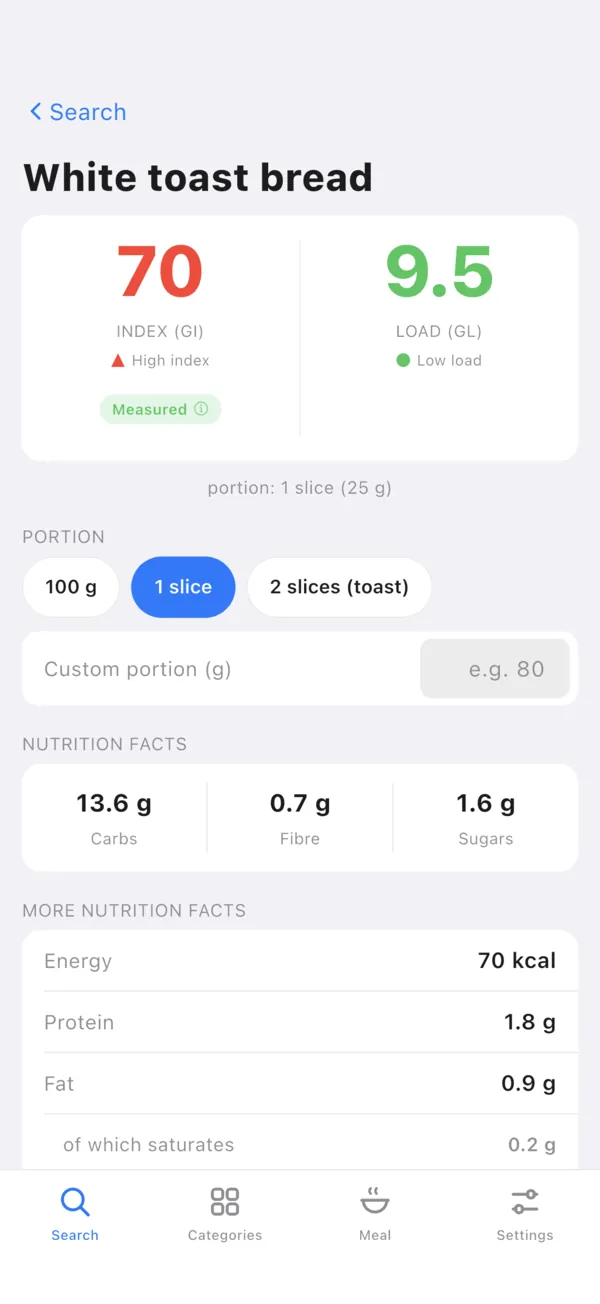
Why load, not just index
The index tells you how quickly the carbohydrate in a food raises your blood sugar. The load adds how much of that carbohydrate is in your portion. Change the portion and watch the load move while the index stays put.
White toast bread, 1 slice (25 g)
Index (GI)
70
High
Load (GL)
9.5
Low
GL = GI × carbohydrate in the portion ÷ 10070 × 13.6 g ÷ 100 = 9.5
Examples from the app’s database. Every one of these indices was measured in a study with human participants. Index thresholds: up to 55 low, 56–69 medium, 70 and above high. Load thresholds: up to 10 low, 10.1–19.9 medium, 20 and above high.
All examples as numbers
| Food and portion | Index (GI) | Load (GL) |
|---|---|---|
| White toast bread source: DOI 10.1017/jns.2022.74 (2022) | ||
| White toast bread, 100 g | 70 High | 38.2 High |
| White toast bread, 1 slice (25 g) | 70 High | 9.5 Low |
| White toast bread, 2 slices (toast), 50 g | 70 High | 19.1 Medium |
| Boiled jasmine rice source: DOI 10.1186/1475-2891-13-50 (2014) | ||
| Boiled jasmine rice, 100 g | 80 High | 22.6 High |
| Boiled jasmine rice, 1 serving (plate), 150 g | 80 High | 33.8 High |
| Boiled jasmine rice, 1 tablespoon cooked (20 g) | 80 High | 4.5 Low |
| Boiled potatoes source: DOI 10.1079/bjn20051571 (2005) | ||
| Boiled potatoes, 100 g | 77 High | 13.1 Medium |
| Boiled potatoes, 1 piece (180 g) | 77 High | 23.6 High |
| Boiled potatoes, 1 tablespoon (30 g) | 77 High | 3.9 Low |
| Banana source: DOI 10.1093/ajcn/34.3.362 (1981) | ||
| Banana, 100 g | 62 Medium | 13.2 Medium |
| Banana, 1 piece (120 g) | 62 Medium | 15.8 Medium |
| Banana, 1 slice (20 g) | 62 Medium | 2.6 Low |
| Apple source: DOI 10.4163/kjn.2012.45.2.192 (2012) | ||
| Apple, 100 g | 34 Low | 3.9 Low |
| Apple, 1 piece (150 g) | 34 Low | 5.8 Low |
| Apple, 1 slice (25 g) | 34 Low | 1 Low |
What Glik does
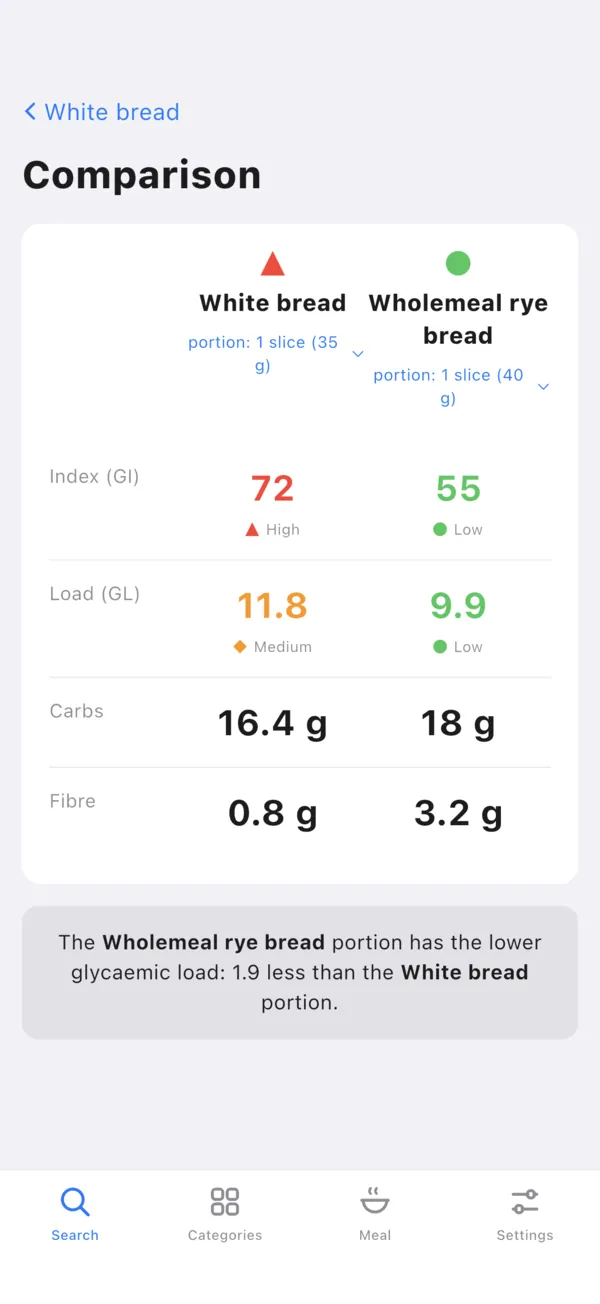
Compare two foods
Index, load, carbohydrate and fibre side by side, each for its own portion.
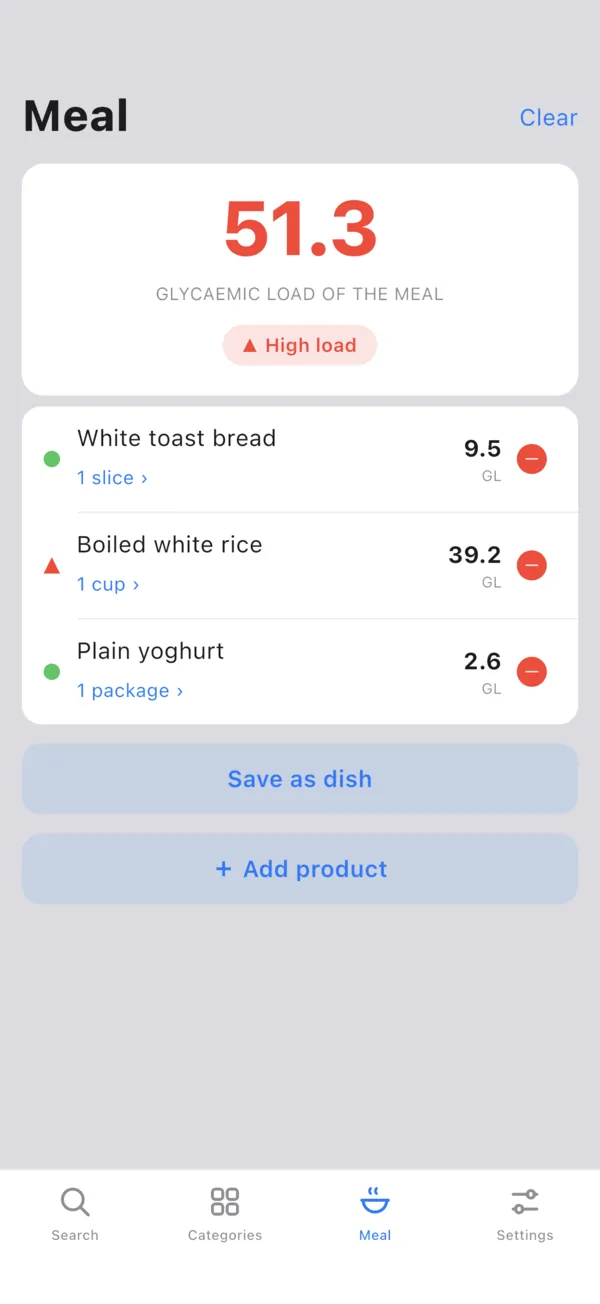
Load of a whole meal
Add a few foods and see the total. Save the meal as your own dish.
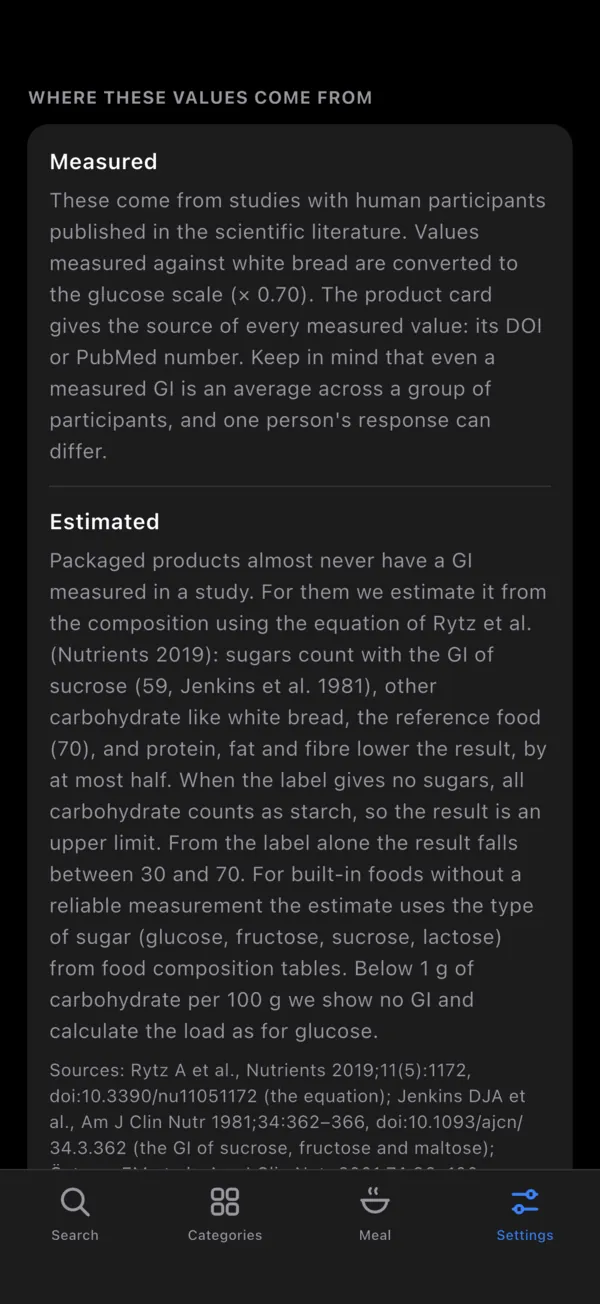
A source for every number
See whether an index was measured in a study or estimated from composition.
Also
- Barcode scanner for packaged foods. It also reads QR and DataMatrix codes on new packaging.
- Your own portion in grams or ounces, plus household measures: slice, tablespoon, cup, piece.
- Better alternatives from the same category: a lower load for the same weight.
- Nutritional values, plus Nutri-Score and processing level for packaged foods.
- Favourites, recently checked foods, and export and import when you switch phones.
- Works without an internet connection. Download several hundred popular packaged foods in one tap.
- Every level shown by colour, shape and word together, so it reads even with colour-vision differences. VoiceOver, TalkBack, large text and dark mode.
Honest data
The built-in database has 126 foods. 70 of them have an index measured in a published study with human participants, and the food card names the source: its DOI or PubMed number.
Where no reliable measurement exists, Glik estimates the index from the composition and always says so: “Estimated”. Packaged foods from the scanner always have an estimated index, because nobody has measured it for them. The method is described in the app, together with the publications.
Pay once, that’s it
One purchase, every feature from the start. No subscription, no account, no sign-in, no ads and no analytics in the app. Your favourites and meals stay on your phone. Privacy policy.
Questions
What is the glycaemic index (GI)?
The glycaemic index describes how quickly the carbohydrate in a food raises blood sugar compared with pure glucose, which scores 100. Up to 55 is low, 56–69 medium, 70 and above high. The index always refers to the same amount of carbohydrate, so it says nothing about portion size.
What is the glycaemic load (GL)?
The load combines the index with the available carbohydrate in a portion: GL = GI × carbohydrate in the portion ÷ 100. Fibre does not count towards the load. Up to 10 is low, 10.1–19.9 medium, 20 and above high. That is why a slice of high-GI bread can have a low load, while a large plate of a medium-GI food can have a high one.
Where do the index values come from?
Measured indices come from published studies with healthy adults, converted to the glucose scale. Each one names its source. Other values are estimated from composition and labelled “Estimated”. Packaged food data comes from Open Food Facts.
Does Glik work offline?
Yes. Search, categories, the food card, the meal and the scanner all work offline. You only need a connection to scan a product that is not on your phone yet. You can download several hundred popular packaged foods in advance with one tap in Settings.
My food isn’t there. What can I do?
Scan the barcode: Glik will look the product up in Open Food Facts. You can also copy the values from the label, and Glik will calculate the load and estimate the index.
Which phones does Glik run on?
iPhones with iOS 15 or later and Android phones with Android 7.0 or later. The app is in English and Polish.
Can Glik replace my doctor or dietitian?
No. Glik is an educational tool, not a medical device. It does not diagnose, treat or monitor any condition. Talk to your doctor before changing your diet or medication.
Another question or some feedback? Write to contact@getglik.com.